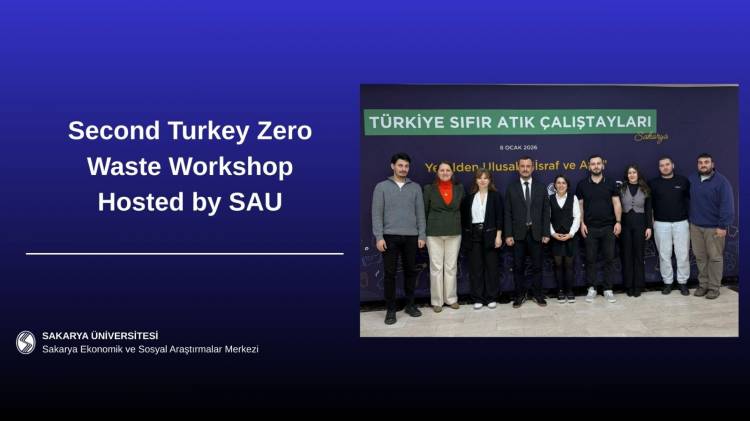
At the second Türkiye Zero Waste Workshop, hosted by Sakarya University (SAU), the issues of waste and waste management were discussed within the scope of 14 thematic tables.
In line with the vision and patronage of Mrs. Emine Erdoğan, Founder of the Zero Waste Movement and Honorary President of the Zero Waste Foundation, the Turkey Zero Waste Workshops series, planned to be implemented in all 81 provinces of Turkey by the Zero Waste Foundation, has begun under the auspices of the Sakarya Governorship and hosted by Sakarya University.
The workshop, held under the theme "Waste and Recycling from Local to National Levels," was organized in collaboration with the Sakarya Governorship, Sakarya Metropolitan Municipality, Sakarya University, Sakarya University of Applied Sciences, Sakarya Provincial Directorate of Agriculture and Forestry, and Sakarya Provincial Directorate of Environment, Urbanization and Climate Change.
During the workshop, the zero-waste approach was evaluated from its environmental, economic, and social dimensions, and policy and action proposals applicable at the Sakarya level were discussed in line with the participants' views.
A call for a holistic approach to zero waste.
Speaking at the opening of the program, Sakarya Deputy Governor Selda Dural emphasized that the zero-waste approach should not be seen merely as a practice aimed at waste disposal. Dural stated that the zero-waste approach offers a comprehensive waste prevention understanding based on reducing waste at its source. Noting that the transformation in production and consumption habits that occurred with the Industrial Revolution has deepened environmental problems, Dural stated that sustainable development and rational consumption have become essential today.
Stating that environmental problems are no longer an area that can be solved solely by the state, Dural emphasized the importance of the active involvement of all stakeholders, from individuals to institutions, in the process. He added that the final document resulting from the workshop will serve as a guide for public institutions and local governments in Sakarya, and that the final document will be shared with the public.
The responsibility of municipalities in preventing waste.
Dr. İlhan Yılmaz, Deputy Secretary General of Sakarya Metropolitan Municipality, stated that the zero-waste approach is more than just an environmental policy; it is a topic that should be addressed with a sense of social responsibility and civilization. He explained that waste is not limited to discarded materials but also encompasses the reckless consumption of labor, time, and resources. Yılmaz added that the metropolitan municipality is carrying out multifaceted work, primarily in waste management, recycling infrastructure, and awareness campaigns. He emphasized that environmental policies that are not strengthened at the local level cannot produce lasting results on a national scale, and that the workshops strengthen the foundation of shared understanding and cooperation.
The coordinating role of universities in the zero-waste process.
Speaking on behalf of host Sakarya University, Vice Rector Prof. Dr. Özer Köseoğlu expressed his pleasure that Sakarya was the second stop in the Turkey Zero Waste Workshops series. Highlighting the importance of local ownership of the zero waste movement and its transformation into concrete, measurable goals, Prof. Dr. Köseoğlu stated that during the workshop, representatives from the public sector, universities, the private sector, and civil society would jointly evaluate what needs to be done specifically for Sakarya. He noted that the aim was to transform the suggestions arising from the day-long discussions into traceable and implementable action plans, and that Sakarya University would follow the process closely.
A multi-faceted approach to the waste problem.
Sakarya University of Applied Sciences Vice Rector Prof. Dr. Oğuz Türkay stated that the waste problem has become a global issue that needs to be addressed not only from an environmental perspective but also from economic, social, and administrative dimensions. Emphasizing that the priority in the zero-waste approach is reducing waste at its source, Prof. Dr. Türkay noted that the least costly solution for the environment is to eliminate waste altogether. He added that the university acts with a sense of corporate responsibility regarding zero waste and environmental sustainability, prioritizing source separation, strengthening recycling infrastructure, digitalization, energy and water efficiency, and awareness campaigns on campus.
Emphasis on food safety in zero waste.
Sakarya Provincial Director of Agriculture and Forestry, Asım Baş, stated in his speech that the zero-waste concept is increasingly transforming into an approach that centers around the concept of waste in the field. He noted that food and water waste, in particular, has become a serious problem on a global scale, highlighting the striking paradox that a significant portion of the food produced is wasted while societies around the world are struggling with hunger. Baş explained that the Ministry of Agriculture and Forestry is conducting intensive work on the sustainability of production, food supply security, and the prevention of waste, and that the workshop would increase awareness and solution-oriented capacity in these areas.
Resource efficiency and recovery objective
Hayrettin Tüdün, Acting Provincial Director of Environment, Urbanization and Climate Change in Sakarya, reminded that the Zero Waste movement was launched in 2017 and quickly transformed into a globally recognized environmental project, transcending national borders. He stated that with the Zero Waste Regulation published in 2019, a broad scope of application was created, encompassing public institutions, the private sector, and households. Tüdün added that significant progress has been made in waste management through the work carried out to date. He expressed that the workshop aims to facilitate the transfer of experience from local to national levels, developing a common perspective on resource efficiency and recycling.
Seeking common solutions at thematic tables.
Within the scope of the workshop, simultaneous studies were conducted at 14 thematic tables organized under four main blocks. The tables consisted of the following topics: “Climate, Disaster and Nature Management”, “Water Management and Irrigation Efficiency”, “Aquatic Ecosystems”, “Food and Organic Cycle”, “Packaging, Plastics and Disposable Products”, “Textiles, Furniture and Consumer Goods”, “Energy Transition”, “Transportation Transition”, “Industry and Trade”, “Transformation Economy”, “Public Spaces”, “Tourism, Hospitality and Event Management”, “Cultural, Educational and Social Transformation”, and “Governance, Institutional Systems, Finance and Data Management”.
The workshop outcomes will be transformed into a roadmap.
During the day-long roundtable meetings, zero-waste efforts in Sakarya were discussed and solutions were developed. The plan is to share the resulting report, prepared based on the workshop's outputs, with relevant institutions and stakeholders, and to transform the defined goals into an implementation roadmap.

